

Why Premium Grocers Should Consider Olive Oil Cookie Mixes
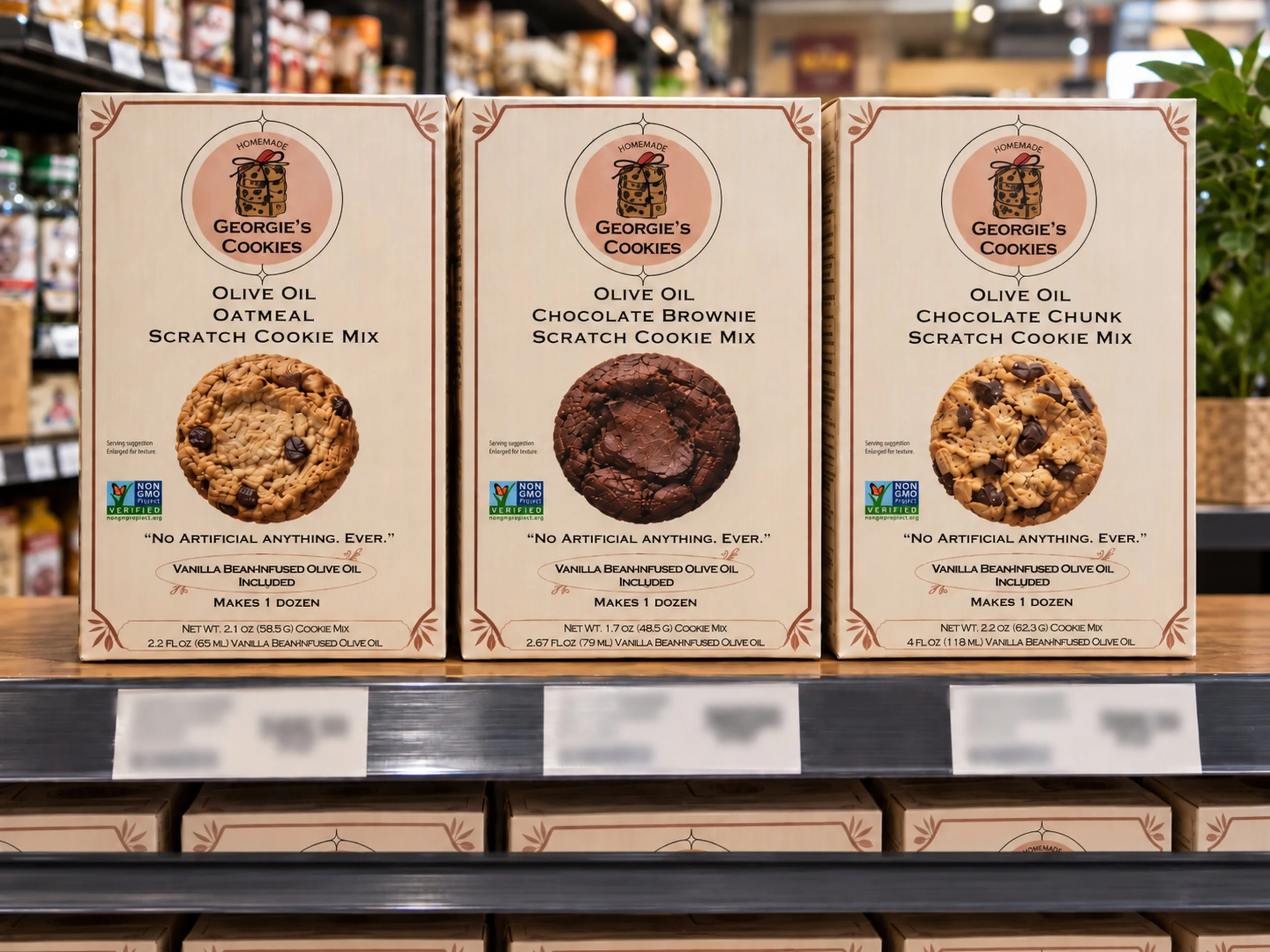
Georgie’s Cookies Olive Oil Scratch Cookie Mixes
The baking aisle has traditionally been built around convenience. Boxed mixes simplify the baking process, reduce preparation time and give consumers predictable results.
But today’s premium grocery shopper often expects more than convenience alone.
They are also looking for interesting ingredients, compelling product stories, recognizable certifications and products that make an ordinary experience feel a little more special.
That creates an opportunity for premium and specialty grocers to take a fresh look at a familiar category: the baking mix.
One emerging approach combines the simplicity of a boxed baking mix with an ingredient consumers already recognize from the premium food world—olive oil.
For Georgie’s Cookies, an Arizona-based cookie company, that idea led to a different kind of product: an Olive Oil Scratch Cookie Mix that includes the measured olive oil needed to make the cookies right inside the package.
Instead of simply selling another bag of dry ingredients, the concept is designed to deliver a more complete baking experience.
Premium Doesn’t Simply Mean a Higher Price
Premium grocery shoppers may be willing to spend more, but they still expect to understand why a product deserves a place in their cart.
NielsenIQ identified value-driven premiumization as one of the major trends observed at the 2025 Summer Fancy Food Show. According to NIQ, successful premium products are increasingly differentiating themselves through factors such as quality ingredients, packaging, origin, storytelling and an elevated consumer experience—not simply a higher price.
That distinction matters in categories like baking mixes.
A traditional cookie mix can be easy to commoditize. Consumers see flour, sugar and chocolate chips in a package and may compare products primarily by price.
A premium mix has an opportunity to tell a bigger story.
Using olive oil as the fat in the recipe—and including that olive oil inside the package—creates a clear point of differentiation that shoppers can understand immediately.
Olive Oil Gives the Baking Aisle a Familiar Premium Ingredient
Consumers already encounter olive oil throughout premium grocery stores—in specialty oils, prepared foods, breads, marinades, dressings and gourmet foods.
Its popularity in the United States is substantial.
The International Olive Council reported that U.S. olive oil imports reached approximately 437,000 metric tons during the 2024/25 crop year, an increase of more than 20% from the previous crop year.
Using olive oil in cookies takes a familiar ingredient and introduces it in a less expected category.
Instead of butter, Georgie’s cookie mixes are formulated around olive oil. That gives retailers an opportunity to introduce shoppers to a different way of baking while keeping the experience familiar and approachable.
The objective isn’t to make cookies complicated.
It is to make a familiar product more interesting.
Convenience Has Become Even More Important
Premium ingredients matter, but convenience cannot be ignored.
The International Food Information Council’s 2026 Food & Health Survey found that 61% of U.S. consumers said convenience influences their food and beverage purchasing decisions, putting convenience ahead of healthfulness for the first time in the survey’s 21-year history. Taste and price remained the two leading factors.
That makes the format of a premium baking mix particularly important.
Consumers may appreciate the idea of baking cookies with olive oil, but requiring them to purchase a separate specialty oil creates another step.
Georgie’s takes a different approach.
The measured olive oil required for the recipe is packaged with the dry cookie mix. The shopper receives the essential signature ingredient as part of the product rather than having to find and purchase it separately.
For the consumer, that means fewer ingredients to gather.
For the retailer, it means the product’s primary differentiating ingredient actually goes home with the customer.
The Rise of Premium Cooking at Home
The movement toward elevated at-home food experiences is not limited to baking.
The Specialty Food Association has identified a growing interest in consumers creating gourmet-quality experiences at home while still wanting convenient formats.
The association’s trend analysts have pointed to products such as fine oils, premium ingredients and baking mixes as examples of the broader movement toward upgrading home cooking.
That creates an interesting space between traditional scratch baking and conventional boxed mixes.
Consumers still get to scoop the dough, put the tray in the oven and smell cookies baking in their kitchen.
But much of the measuring and ingredient sourcing has already been done.
A well-designed premium mix doesn’t eliminate the baking experience.
It removes some of the friction around it.
Third-Party Verification Can Add Shelf Credibility
Ingredient claims have become increasingly prominent on food packaging, making recognizable third-party verification especially useful.
Three of Georgie’s Cookies’ core Olive Oil Scratch Cookie Mixes are Non-GMO Project Verified.
The Non-GMO Project explains that products displaying its Butterfly verification mark have been evaluated by third-party technical administrators and must comply with the organization’s standard for GMO avoidance.
For a premium retailer, third-party verification provides something different from a company’s own marketing statement.
It gives shoppers a recognizable symbol on the package connected to an established verification program.
Combined with olive oil and a premium baking format, that can provide additional differentiation at shelf.
A Baking Mix Can Tell a Regional Story
Premium grocery stores frequently succeed by offering shoppers products they will not necessarily find in every conventional supermarket.
Local and regional brands can play an important role in that assortment.
Georgie’s Cookies was developed in Arizona and built its cookie business by selling baked cookies directly to customers before expanding into packaged scratch cookie mixes.
That origin gives the retail product a story beyond the ingredients in the package.
It allows a retailer to merchandise the product as a specialty baking item, an emerging regional brand, a food gift or part of a locally focused assortment.
For retailers in Arizona and the Southwest in particular, the olive-oil positioning also creates natural merchandising opportunities alongside specialty oils, locally produced foods and premium pantry products.
The Package Can Become the Baking Experience
There is also a fundamental merchandising difference between a conventional mix and an all-in-one premium concept.
Imagine two products sitting next to each other.
One provides the dry ingredients and tells the shopper what additional ingredients they need to purchase at home.
The other provides the mix and the olive oil that defines the recipe.
That additional component gives the shopper something tangible that helps explain the premium positioning.
It can also make the product particularly suitable for gifting.
A shopper purchasing a food gift may not know whether the recipient has a particular specialty oil in the pantry. Including the oil makes the product more self-contained and easier to give.
Seasonal baking displays, holiday gift sections, specialty-food displays and gourmet pantry sections therefore become potential merchandising locations beyond the traditional baking aisle.
Why Premium Grocery Buyers Should Look Beyond the Traditional Mix
The strongest specialty products typically solve more than one problem.
They provide convenience while still giving shoppers an experience.
They introduce something different while remaining easy to understand.
And they provide enough differentiation that the retailer has a story to tell at shelf.
An olive oil cookie mix with the oil included can address each of those opportunities.
For Georgie’s Cookies, the proposition is straightforward:
A scratch-style cookie experience.
The measured olive oil included inside the package.
Non-GMO Project verification on three core mixes.
And a product designed to turn an established grocery category into something shoppers may not have encountered before.
Premium grocery doesn’t have to mean making food more complicated.
Sometimes premium means making a familiar experience better, easier and more interesting.
For retailers looking to differentiate their baking assortment, that may be reason enough to take another look at the cookie mix aisle.
Sources and Further Reading
International Food Information Council — 2026 Food & Health Survey
NielsenIQ — Summer Fancy Food 2025: Top Trends That Stood Out
Specialty Food Association — Food Trend Predictions
International Olive Council — Olive Sector Statistics
Non-GMO Project — What Is Non-GMO Project Verified?